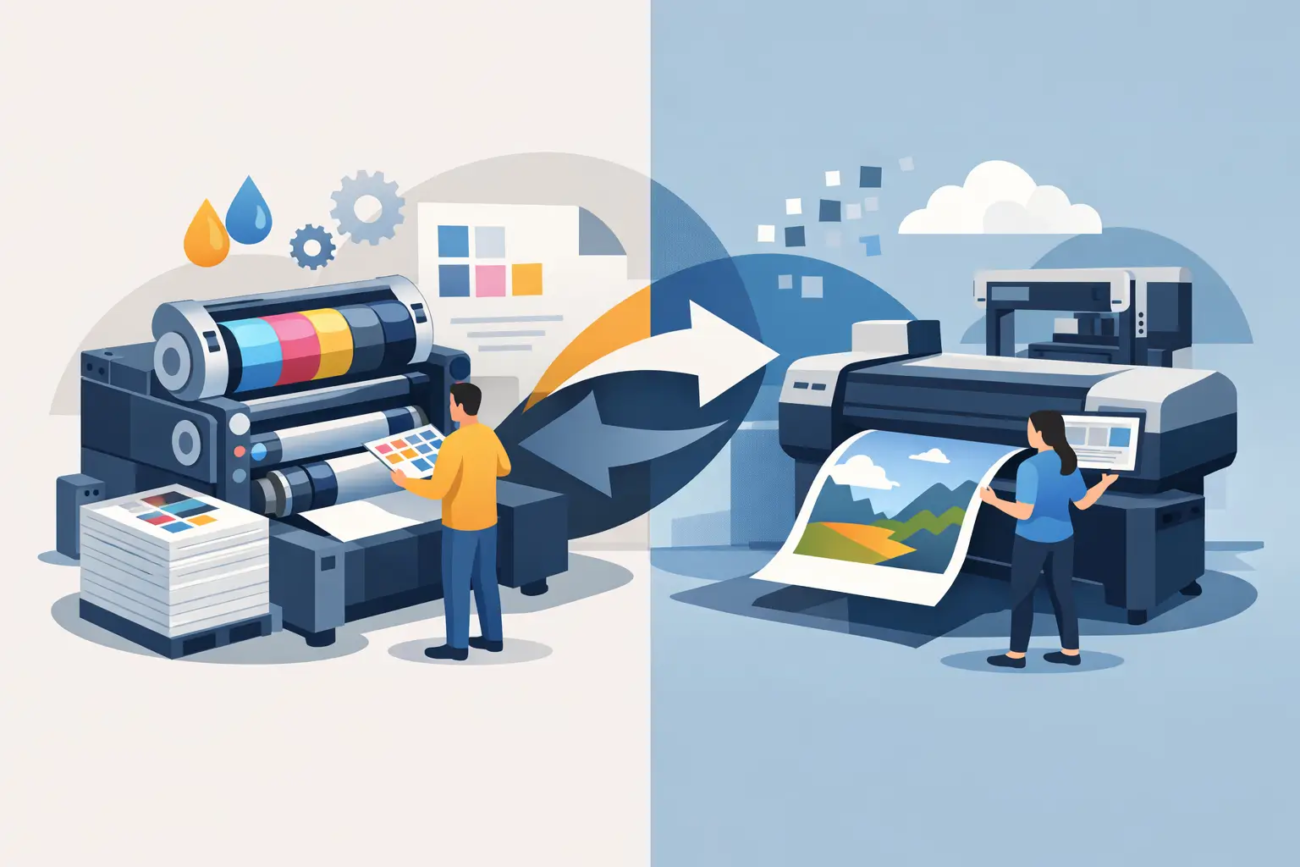
A stack of brochures in a box does not count as a marketing strategy. For most owners, the real challenge is not getting something printed. It is choosing the right piece, putting it in front of the right people, and making sure the cost turns into calls, visits, or sales. This small business print marketing guide is built for that reality.
Print still works for local reach, event promotion, sales support, and brand credibility. It gives people something they can hold, save, share, and act on later. But it only performs when the message, format, timing, and distribution all line up. That is where many small businesses waste money without realizing it.
What a small business print marketing guide should help you decide
The first question is not, “What should we print?” It is, “What job does this piece need to do?” A flyer for a grand opening has a different purpose than a brochure used by a sales rep. A postcard for direct mail needs a faster message than a rack card displayed at a front desk. When the objective is clear, the print format becomes much easier to choose.
Most small businesses use print in one of a few practical ways. They need to generate local awareness, support a sales conversation, promote an event, encourage repeat business, or reinforce brand visibility in a physical location. Each goal points to different materials and different expectations for results.
If you want immediate response, direct mail, postcards, door hangers, and promotional handouts tend to perform better than long-form pieces. If you need to explain services or build confidence, brochures, sell sheets, presentation folders, and branded leave-behinds usually do more work. If your priority is visibility, signage, banners, window graphics, and large-format materials may produce a stronger return than paper collateral.
Start with the audience, not the format
Print marketing works best when it reflects how your audience actually buys. A local homeowner choosing a landscaping company behaves differently than a business administrator sourcing vendors for an association event. One may respond to seasonal offers and neighborhood mailings. The other may need polished printed materials that support a professional review process.
That means your targeting matters as much as your design. If you are mailing to a broad local audience, the offer has to be simple and immediately relevant. If you are handing materials to prospects after meetings, the information needs to be more detailed and organized. If the piece will sit in a lobby, waiting room, or trade show booth, it needs to communicate value quickly even without a salesperson present.
There is also a timing question. Some businesses should print evergreen materials they can use for months, such as brochures, business cards, and signage. Others benefit more from campaign-based print, such as postcards for a seasonal push, event programs, or limited-time promotional pieces. Neither approach is better in every case. It depends on how often your message changes and how quickly you need to respond to market opportunities.
Choosing the right print materials
A practical small business print marketing guide should be honest about trade-offs. Not every business needs every printed item.
Business cards still matter because they are low-cost, easy to distribute, and useful in networking, field sales, and service visits. But they are not enough on their own. If your sales process involves explaining multiple services, pricing options, or examples of past work, a brochure or sell sheet gives prospects something more useful to keep.
Postcards are one of the strongest tools for local promotions because they are affordable, direct, and easy to scan. They work well for sales, service reminders, event invitations, and neighborhood targeting. The limitation is space. If your message is complicated, a postcard can create interest, but it may not carry the full story.
Brochures are stronger when your audience needs more context. They help service businesses explain capabilities, industries served, differentiators, and next steps. The trade-off is that brochures require better planning. Weak copy, dated design, or generic messaging becomes obvious fast.
Large-format signage is often overlooked in print planning, but for storefronts, events, trade shows, schools, and community organizations, it can be one of the most efficient visibility tools available. A banner or yard sign does not need a lot of words to work. It just needs the right message in the right place.
Direct mail deserves special attention because it gives small businesses a way to reach specific local audiences without depending only on digital platforms. It also works well alongside online campaigns. A mailed piece can drive traffic to a landing page, reinforce a social campaign, or support a sales follow-up.
Design for response, not decoration
Good print design is not about filling space with logos and color blocks. It is about making the next action obvious.
That starts with hierarchy. People should be able to tell, within seconds, what you offer, who it is for, and what to do next. If your headline is vague, your offer is buried, or your contact information is hard to find, the piece is underperforming before it ever leaves the press.
Images should support the message, not distract from it. For local businesses, authentic photos often outperform generic stock visuals because they build trust. That said, not every company has strong original photography ready to go. In those cases, simple and clean design usually works better than trying to force a polished look with unrelated imagery.
Copy matters just as much as design. Print gives you limited space, so every sentence has a job. Focus on concrete value: faster service, easier ordering, local expertise, seasonal offers, proven results, or clear differentiators. Avoid broad claims that any competitor could make.
And always include a clear call to action. Call for an estimate. Bring in this postcard. Visit our website. Book before a deadline. Ask about a custom package. If you do not tell people what to do next, many of them will do nothing.
How to control print costs without lowering quality
Small businesses often assume saving money means ordering the cheapest option. In practice, that can lead to more waste.
The smarter approach is to match the piece to the purpose. If you are printing a mass-distribution flyer for a short-term event, you may not need premium stock or specialty finishes. If you are producing a capabilities brochure for high-value prospects, better paper and sharper presentation may be worth the investment.
Quantities matter too. Ordering too few can raise your unit cost, but ordering too many can leave you with outdated materials. This is especially true if your pricing, staff, services, or branding changes often. Businesses with frequent updates may be better off printing smaller runs more regularly.
Consolidating design, printing, and campaign planning can also reduce costly mistakes. When several vendors handle separate parts of a project, details get lost. Files arrive in the wrong format. Mailing specs get missed. Timelines slip. Working with one responsive partner can make the process faster, cleaner, and easier to manage, especially when deadlines are tight.
Measuring what print actually does
One reason some companies abandon print too early is that they do not track it. If a campaign goes out without a specific offer, landing page, promo code, phone number, or response window, it becomes hard to know what worked.
You do not need complicated reporting to improve print performance. Use a unique offer. Set a campaign window. Ask new customers how they heard about you. Compare response rates by audience, neighborhood, event, or message. Over time, those small data points help you make much better decisions.
Print usually performs best as part of a broader marketing system. A postcard can bring attention. A website can answer questions. A follow-up email can close the gap. Signage can reinforce familiarity. That mix is where many small businesses gain traction, because customers rarely act after a single impression.
Common mistakes that waste print budgets
The biggest mistake is printing before the message is ready. Rushing to production without a clear offer, audience, or distribution plan leads to materials that look fine but do very little.
Another common problem is using the same piece for every situation. A handout for an event should not necessarily be the same as a mailer for local households or a leave-behind for a sales appointment. Reusing one format everywhere may feel efficient, but it often lowers response.
There is also the issue of inconsistency. If your print materials do not match your website, signage, or overall brand presentation, trust takes a hit. Small businesses do not need a complex brand system, but they do need consistency in message, contact details, and visual identity.
For companies that need dependable execution across print, design, mail, and digital support, working with an integrated partner such as Fox Tracks can simplify the process and reduce delays.
The best print marketing is not flashy. It is clear, timely, well-targeted, and built to support a real business goal. If each printed piece has a purpose and a plan behind it, your marketing budget starts working a lot harder than a box of leftover flyers ever will.