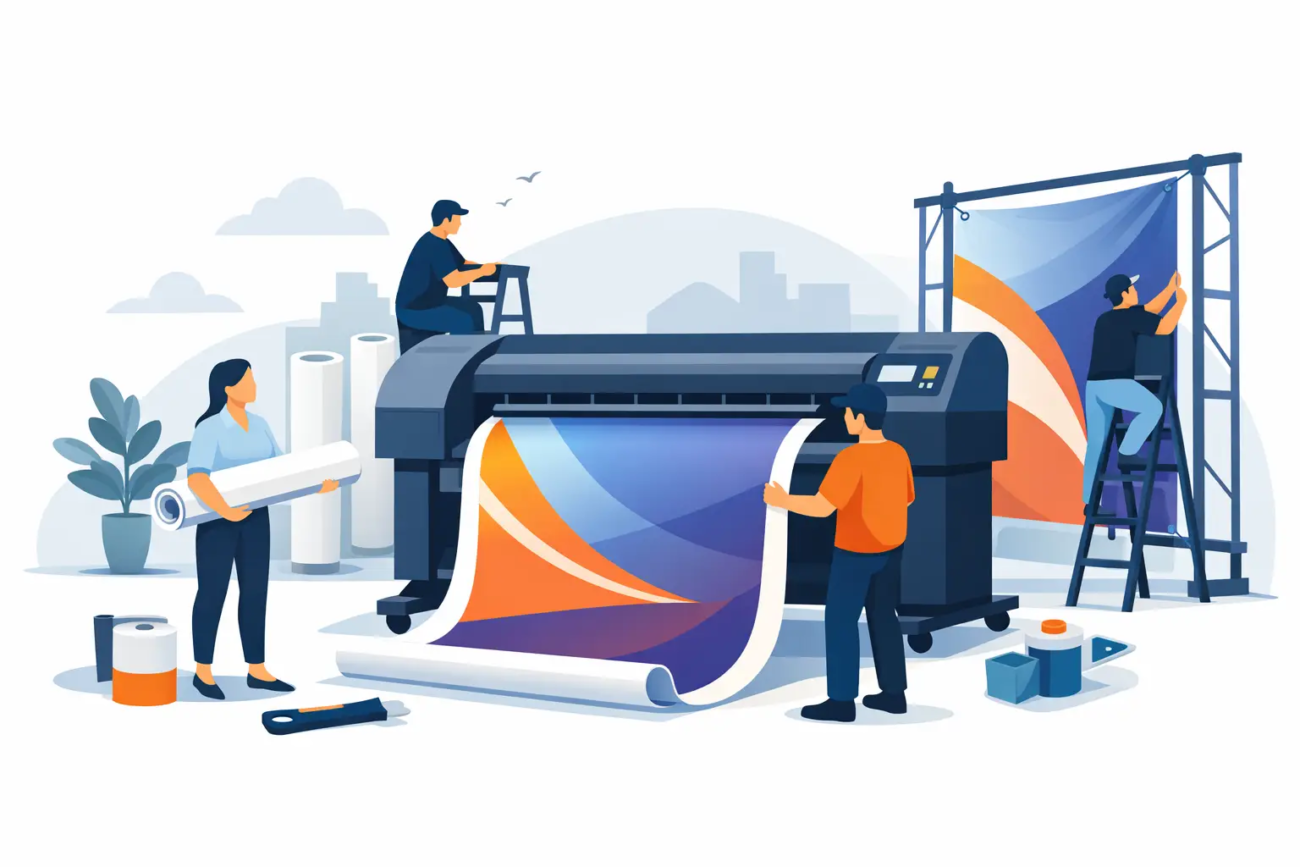
A banner usually has one job – get noticed fast. But in practice, large format banner printing also has to do a few other things well. It needs to hold up outdoors, read clearly from a distance, fit the space, match your brand, and arrive on time. If any one of those pieces is off, the banner becomes expensive background noise instead of a useful marketing tool.
For small and mid-sized businesses, local organizations, and event teams, banners are often one of the most cost-effective ways to create visibility quickly. They work at trade shows, fundraisers, retail promotions, community events, job fairs, school functions, and temporary wayfinding setups. The reason they stay popular is simple: they are flexible, affordable, and easy to deploy when you need a message in the real world, not just on a screen.
Why large format banner printing still matters
Digital marketing does a lot of heavy lifting, but physical visibility still matters when people are already near your business, your booth, or your event. A banner can reinforce a campaign, announce a special offer, direct traffic, or help your space look organized and professional. It gives people something immediate to see and respond to.
That is especially true for organizations trying to do more with lean internal teams. When you need signage that supports a launch, open house, seasonal promotion, or community event, banners are often the fastest answer. They can cover a lot of visual ground without the production cost of permanent signage.
There is also a practical advantage that often gets overlooked. Banners are portable. You can reuse them across multiple events, move them between locations, or keep them on hand for recurring promotions. If the design is built with longevity in mind, a single banner can support your marketing well beyond one campaign.
Choosing the right banner for the job
Not every banner is meant for the same environment. That sounds obvious, but it is where many projects start to go sideways. A banner that looks good in a lobby may fail outdoors in wind and sun. A banner designed for a fence may not hang correctly on a display stand. Material, finishing, and installation matter just as much as artwork.
Vinyl is a common choice because it is durable, versatile, and suited to both indoor and outdoor use. Mesh banners are better when wind is a factor, such as construction fencing or outdoor event perimeters. Fabric can work well for indoor displays where a softer, more polished appearance is the goal. Each option has trade-offs. Vinyl is durable but heavier. Mesh reduces wind resistance but slightly softens the printed image. Fabric photographs well indoors but is not always the best fit for rough outdoor conditions.
Sizing also needs more thought than many buyers expect. Bigger is not always better. The right size depends on viewing distance, placement, and message length. A banner over a stage needs different proportions than one above a storefront entrance or along a roadside fence. If the banner is too small for the setting, it disappears. If it is too large for the hardware or installation surface, it creates headaches before it ever starts doing its job.
What makes a banner effective
Good banner design is not about squeezing in every possible detail. It is about making the message readable in seconds. Most people will not stand in front of a banner and study it. They glance. That means your headline, logo, offer, and contact point need to be organized with discipline.
The strongest banners usually start with one clear objective. Maybe you are promoting an event date, introducing a new location, advertising a sale, or helping attendees find registration. Once the objective is clear, the design can support that purpose instead of fighting it.
A few practical rules consistently make banners perform better. Keep the headline short. Use strong contrast between background and text. Choose fonts that remain legible at a distance. Limit secondary details to only what a viewer truly needs. If there is a call to action, make it visible without turning the layout into clutter.
Brand consistency matters too. Your banner should look like it belongs to the rest of your marketing. Colors, logos, and messaging should align with your other materials so customers get a clear and professional impression. This is one reason businesses often benefit from working with a provider that understands both print production and broader campaign execution.
Large format banner printing for events, retail, and local promotion
Different uses call for different production decisions. For events, portability and setup speed often matter most. Retractable or grommeted banners need to travel well and install without wasting staff time. In retail, durability and visual impact tend to lead the conversation, especially for sidewalk promotions, grand openings, and seasonal sales. For nonprofits, schools, and associations, cost efficiency and reusability are often major priorities because the same signage may support annual events over several years.
Local promotion brings another layer of strategy. A banner should not just exist on its own. It should support a larger goal. If you are promoting an event, the banner should match your postcards, social posts, email graphics, and registration messaging. If you are driving traffic to a storefront, it should reinforce the same offer customers see online or in direct mail. That consistency improves recall and makes your marketing feel organized rather than pieced together.
This is where a centralized marketing partner can save time and reduce mistakes. When the same team can coordinate design, print, campaign messaging, and deadlines, your banner becomes part of a system instead of a standalone rush job.
Common mistakes in large format banner printing
The most common problem is overcrowding. Businesses try to fit a brochure onto a banner and end up with something nobody can read. A banner is not the place for every service, every sponsor name, and every sentence of context. If the message cannot be understood quickly, the banner loses value.
Low-resolution artwork is another frequent issue. Designs that look acceptable on a laptop screen can fall apart when enlarged. Pixelated logos, blurry product images, and stretched graphics make a business look unprepared. Production files should be built specifically for large-scale output, not pulled from random attachments or old documents.
Installation details also cause preventable problems. If the banner will be hung outdoors, finishing options like grommets, hems, pole pockets, or reinforced edges need to fit the installation method. Without that planning, even a well-printed banner can sag, tear, or fail early.
Then there is timing. Banner projects often get pushed to the last minute because they seem simple. Sometimes they are simple. Sometimes they are not. Proofing, revisions, hardware compatibility, shipping, and installation planning all take time. If a deadline is fixed, the smartest move is to start early enough to avoid rushed compromises.
How to plan a banner project that stays on track
Start with the basics: where the banner will be used, how far away people will view it, how long it needs to last, and what action you want people to take. Those answers shape almost every production choice that follows.
Next, gather clean brand assets and final copy before design begins. That includes logos, approved colors, dates, contact details, and any required sponsor or partner marks. Delays often happen not in printing, but in waiting for content decisions.
It also helps to think beyond the banner itself. Will it be paired with flyers, table covers, yard signs, window graphics, or social graphics? If so, coordinating those pieces upfront usually creates a better result and avoids duplicated effort. At Fox Tracks, that broader view is often what helps clients save time while keeping campaigns consistent.
Finally, review the proof with real-world use in mind. Ask whether the headline can be read quickly, whether the key details are large enough, and whether the file reflects the actual hardware or installation method. A banner can be beautifully designed and still miss the mark if it does not fit the context.
The real value is reliability
The best banner is not just the one with sharp print and bold color. It is the one that arrives when promised, installs correctly, and supports the result you were aiming for in the first place. For business owners and managers balancing events, promotions, staffing, and deadlines, that reliability matters as much as the finished piece.
Large format banner printing works best when it is treated as part of a practical marketing plan, not a last-second add-on. With the right material, message, and production support, a banner can do exactly what good marketing should do – make your business easier to find, easier to understand, and harder to ignore.
If you are planning signage for an event, promotion, or ongoing visibility campaign, the smartest first step is not choosing a font or a color. It is making sure the banner has a clear job to do and a team behind it that will get it done right.