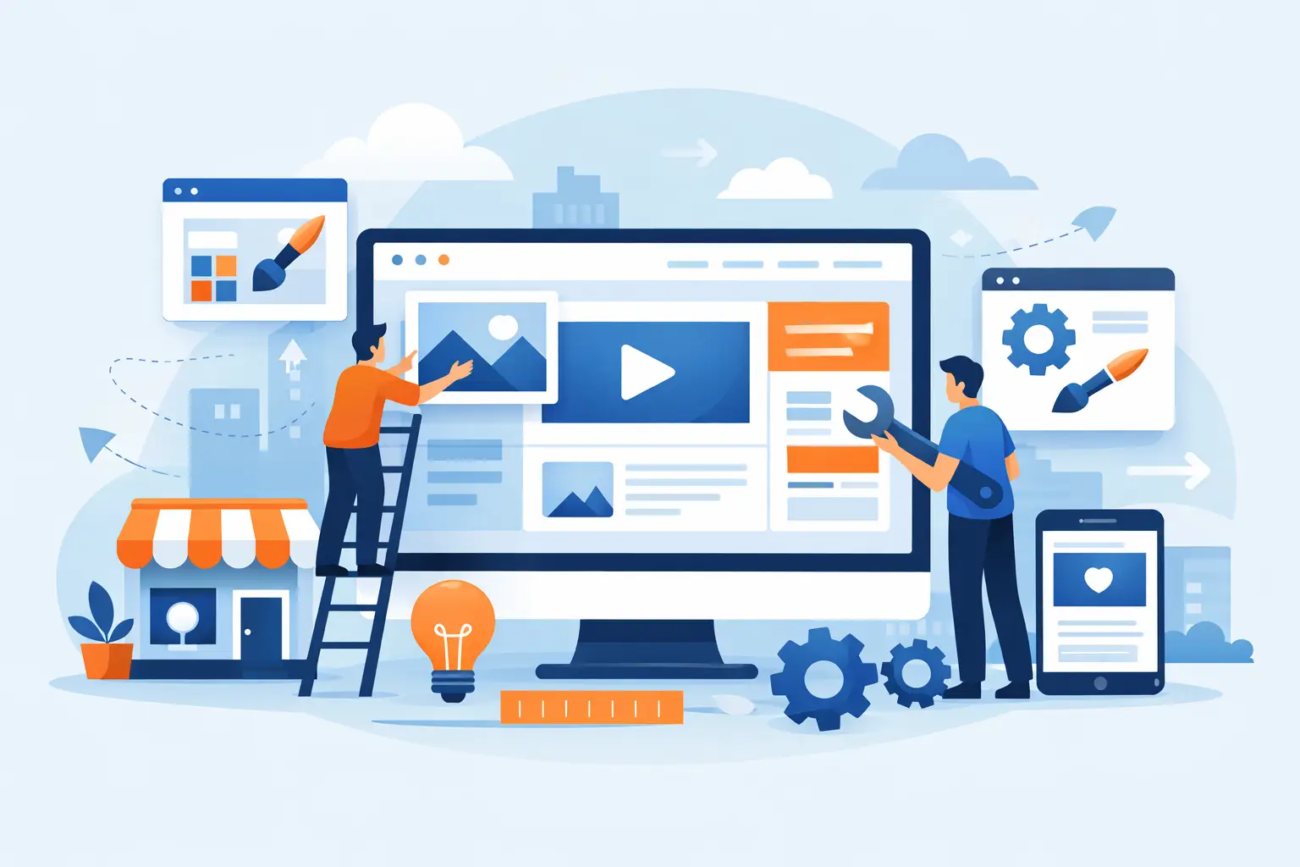

A small business website has a short window to make the right impression. If a visitor lands on your site and cannot tell what you do, who you serve, or how to contact you within a few seconds, that visit may be over before it starts. That is why small business website design services matter so much. They are not just about making a site look polished. They are about building a site that supports sales, marketing, credibility, and day-to-day operations.
For many business owners, the real challenge is not deciding whether they need a better website. It is figuring out what kind of help will actually move the needle. Some providers focus only on visuals. Others hand over a template and call it done. A more useful approach starts with your business goals and builds a website around how customers find you, evaluate you, and reach out.
What small business website design services should actually do
A good website should work like a reliable employee. It should answer common questions, present your business clearly, and make it easy for visitors to take the next step. That next step might be a phone call, a quote request, an event registration, a donation, or a store visit. The exact goal depends on the organization, but the website should always support action.
That means design is only one part of the job. Structure, messaging, page speed, mobile usability, local search visibility, and accessibility all play a role. If any one of those pieces is weak, the whole website feels weaker than it should.
Small businesses often feel pressure to choose between affordability and quality. In reality, the better question is whether the service is focused on the right priorities. A smaller site with clear messaging, fast performance, and strong contact paths will usually outperform a larger site filled with pages no one uses.
The difference between a pretty site and a useful one
It is easy to be impressed by motion effects, oversized images, and stylish layouts. Those elements can have a place, but they should never get in the way of clarity. A useful business website puts information where people expect to find it. Services should be easy to scan. Contact details should be obvious. Calls to action should be visible without feeling pushy.
This is especially important for local businesses, associations, and service providers. Many visitors are not browsing for fun. They have a problem to solve. They want to know if you can help, if you are credible, and how quickly they can reach you. If your website answers those questions directly, it starts doing real work.
There is also a practical trade-off here. Highly customized websites can offer more control and stronger branding, but they often require a bigger budget and a longer timeline. Template-based builds can be more cost-effective and faster to launch, but they need careful planning to avoid looking generic. The right choice depends on how complex your business is, how competitive your market is, and how much flexibility you need later.
Core features to expect from small business website design services
When evaluating small business website design services, it helps to think beyond the homepage. A strong service should address the full customer experience, from first impression to conversion.
At a minimum, your site should be mobile-friendly, easy to navigate, and built with clear service pages. It should load quickly, include simple lead capture options, and reflect your brand consistently across text, images, and layout. If local visibility matters, it should also support local SEO fundamentals such as location-focused copy, organized page structure, and proper metadata.
Accessibility is another area that should not be treated as optional. An ADA-aware website is not just about compliance concerns. It is about making your business easier to use for more people. Clear contrast, readable text, keyboard-friendly navigation, and properly structured content improve usability for everyone.
Good website design services also account for what happens after launch. Can someone on your team update a staff bio, add an event, or swap out a banner without needing a developer every time? If not, routine updates become slow and expensive. A practical website should be manageable.
Why strategy matters before design starts
One of the most common website mistakes is starting with design before deciding what the website needs to achieve. That usually leads to revisions, delays, and pages that look fine but do not support the business.
A better process begins with a few practical questions. Who is the site trying to reach? What services or products matter most? What action should a visitor take first? What information does your audience need before they are ready to contact you?
The answers shape everything from page structure to content length. A contractor may need project photos, service area details, and strong quote-request forms. A nonprofit may need event pages, donation paths, and volunteer information. An association may need member resources, registration pages, and clearly organized updates. Different goals require different design decisions.
This is where working with a provider that understands both marketing and production can save time. When website planning connects with your print materials, email campaigns, signage, or direct mail, your brand becomes more consistent and your marketing works harder as a whole.
Content is part of the design job
Many business owners assume the design is the hard part and the wording can be filled in later. In practice, weak content is one of the fastest ways to undercut a new website. Visitors need plain answers. Search engines need context. Your team needs language that reflects the business accurately.
That does not mean every page needs to be long. It means each page should have a purpose. Service pages should explain what you offer, who it is for, and what makes your process dependable. About pages should build trust without drifting into vague claims. Contact pages should remove friction, not add it.
Professional website design services should help organize and refine that message. If the provider treats content like an afterthought, you may end up with a site that looks complete but still does not convert.
What to watch for when hiring a website partner
Not all website providers are set up to support small businesses well. Some are talented designers but weak on business strategy. Others are low-cost and fast, but disappear when updates are needed. The right partner should be responsive, clear about scope, and realistic about timelines.
Ask how they handle content, revisions, mobile design, SEO basics, and post-launch support. Ask whether they build with future updates in mind. Ask what happens if your business adds a new service or wants to expand the site later.
You should also look at how they think about deadlines and execution. A website project often connects to other moving parts such as a rebrand, a mail campaign, a trade show, or a seasonal promotion. Delays on the website can create delays everywhere else. Reliability matters as much as creativity.
For many organizations, working with one partner for web, print, and marketing support is more efficient than managing multiple vendors. It reduces handoff issues, speeds up approvals, and helps campaigns stay consistent from postcards to landing pages. That integrated approach is one reason businesses turn to partners like Fox Tracks when they want practical execution, not just design files.
The best website is the one that supports growth
A small business website does not need every feature under the sun. It needs to do the right jobs well. It should represent your brand professionally, help people find what they need, and create a clear path to action. If it can also support search visibility, campaign traffic, and routine updates without slowing your team down, it becomes a real business asset.
That is why the best small business website design services are grounded in usability, strategy, and follow-through. They balance budget with performance. They keep design aligned with business goals. And they give you a website that is built to support the next stage of growth, not just the launch date.
If your current site feels outdated, hard to manage, or weak at generating leads, that is usually not just a design issue. It is a sign that your website is ready to do more for your business.